
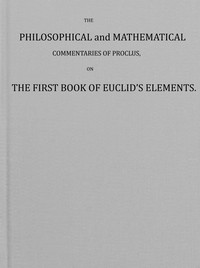
The philosophical and mathematical commentaries of Proclus on the first book of…
Let's be clear: this isn't a novel. There's no plot twist on page 300. But there is a story—the story of a brilliant man trying to save a whole way of thinking.
The Story
Imagine you're Proclus. The Roman Empire is fading. A lot of the old knowledge is in danger of being lost. You're part of the last great philosophical school in Athens, and you see Euclid's 'Elements'—a book of geometry—as more than just math. You see it as the key to understanding Plato's philosophy and the very structure of the cosmos. So, you sit down to write a guide. Line by line, definition by definition, you explain Euclid's work. But you don't just give the answer. You pour everything into it: your beliefs about gods, souls, and how abstract ideas shape our physical world. You're not just commenting on a math book; you're building a bridge between the human mind and the divine, using geometry as your blueprint.
Why You Should Read It
Reading Proclus is like getting a backstage pass to a radically different worldview. What hooked me was the sheer audacity of it. He looks at a simple geometric point—a thing with no parts—and sees the origin of all creation, a spark of the divine. His writing has this intense, almost devotional quality. It reminds you that for centuries, the sharpest minds didn't separate science, religion, and philosophy. They were all part of one big quest for truth. It makes you look at the world differently. Suddenly, the order in a snowflake or the spiral of a shell feels less random and more like a whisper of a much larger order.
Final Verdict
This is not for everyone. If you want a quick, easy read, look elsewhere. But if you're the kind of person fascinated by the history of ideas, or if you love philosophy and want to see it applied in a totally unexpected way, this is a treasure. It's perfect for history buffs, armchair philosophers, and anyone who's ever felt there might be more to math than just numbers on a page. It's a challenging, unique, and profoundly rewarding glimpse into a mind that saw magic in mathematics.
No rights are reserved for this publication. Thank you for supporting open literature.
David Smith
10 months agoExceptional clarity on a very complex subject.
Matthew Perez
5 months agoHaving followed this topic for years, I can say that the way it challenges the status quo is both daring and well-supported. I am looking forward to the author's next publication.
Michael Martin
8 months agoThe clarity of the concluding remarks is very professional.
John Perez
3 months agoI've gone through the entire material twice now, and the transition between theoretical knowledge and practical application is seamless. This exceeded my expectations in almost every way.



Susan Jones
4 months agoThe clarity of the introduction set high expectations, and the evidence-based approach makes it a very credible source of information. A trustworthy resource that I'll keep in my digital library.